Skip to content
A laid patio of large pale slabs with planted borders running along both edges

Patio installers in Hampshire

Porcelain, natural sandstone and concrete flags, set out by hand on a sub-base that is dug, compacted and drained properly before a single slab goes down.

Patios & outdoor living

Porcelain, Natural Sandstone & Block Paving

Three very different surfaces, laid the same careful way. Whichever you choose, the patio is set out from the house, laid on the right bed for the material, jointed to suit it and given a fall that takes water away from the building.

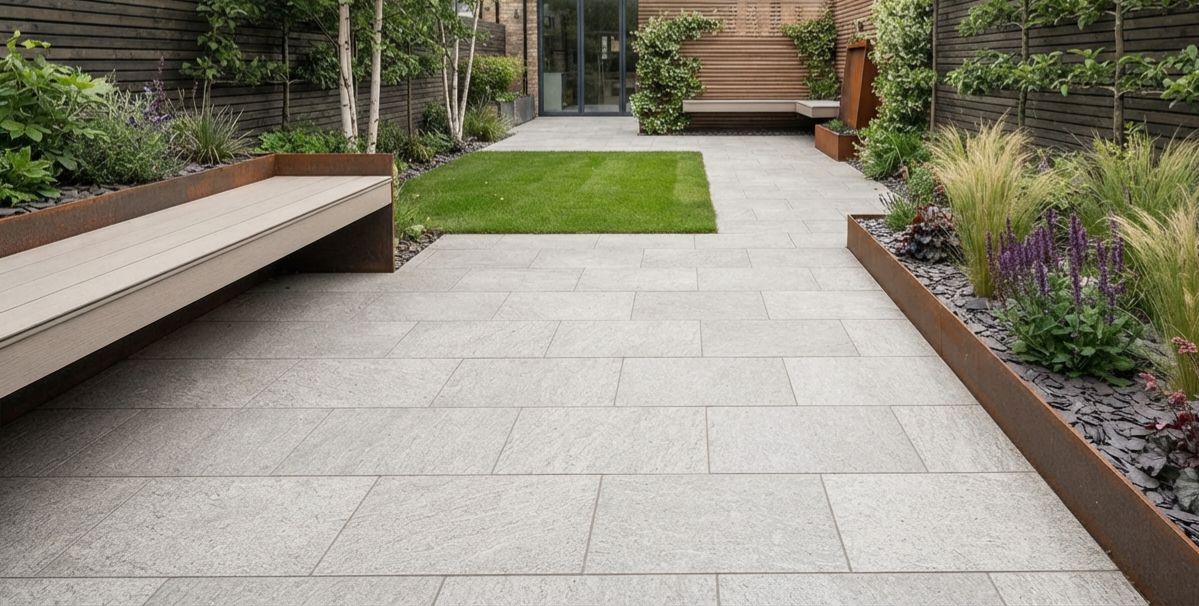
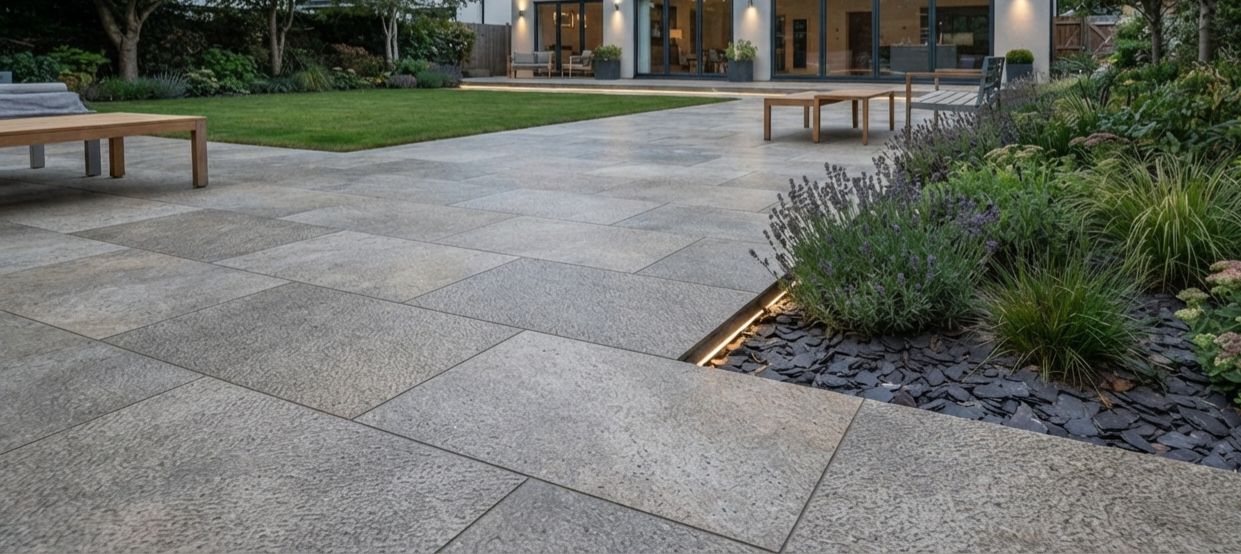
Large format grey porcelain patio beside a lawn and planted border

Non-slip porcelain

Porcelain is fired to a very low porosity, so it does not drink water, does not stain from a spilled glass of red and does not go green the way a soft stone will on a shaded north facing garden. We fit 20mm outdoor grade slabs with a textured face, normally rated R11, which stays grippy underfoot when it is wet.

The trade off is that porcelain is unforgiving to lay. It has almost no water absorption, so the back of every slab is primed with a slurry before it is bedded, otherwise it will simply let go of the mortar in a year or two. Cuts are made with a wet diamond blade so the glazed edge does not chip.

  • 20mm outdoor grade, R11 slip rating
  • Slurry primed backs on every slab
  • Frost resistant and colour stable
  • No sealing required, a wash down is enough
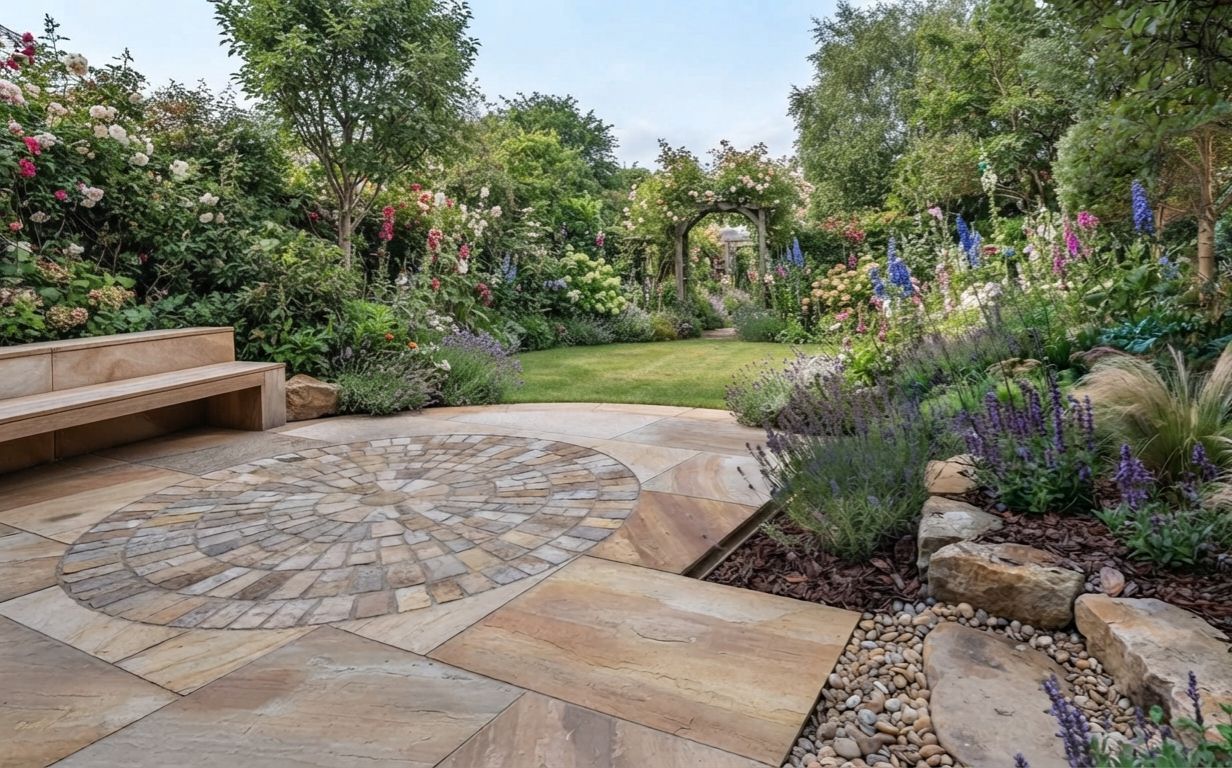
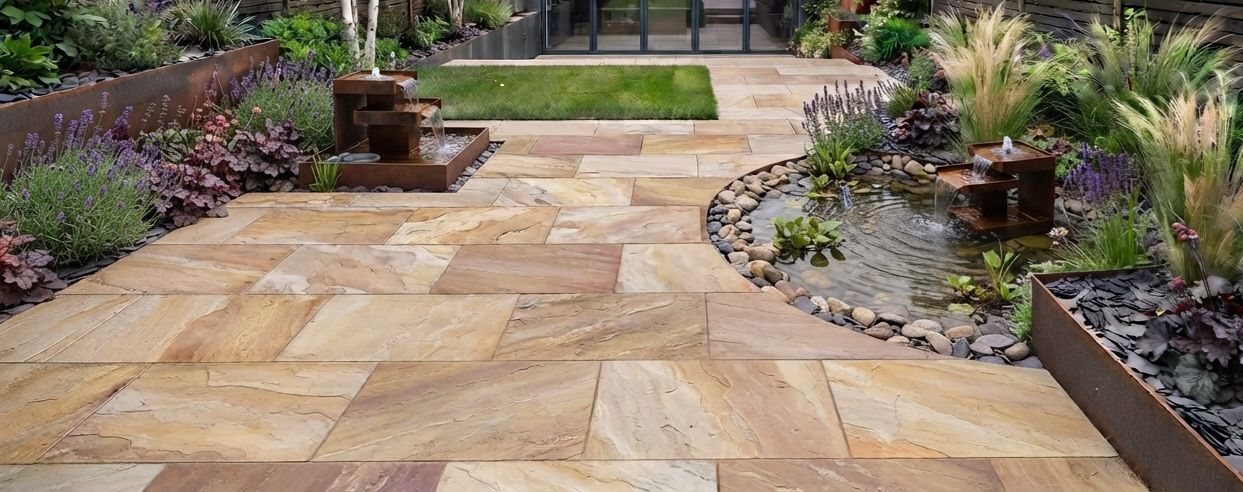
Natural Indian sandstone patio in warm tones with a circular feature and planted borders

Natural Indian sandstone

Indian sandstone is quarried, not manufactured, so every slab carries its own colour and grain. It gives a softer, older looking patio than porcelain and it suits a period house or a cottage garden far better. Riven sandstone keeps the split face from the quarry. Sawn and calibrated sandstone is cut flat on all six sides for a tighter, more modern joint.

Because it varies, it has to be laid thoughtfully. We open several packs at once and dry lay across them, so the darker and lighter slabs are spread over the whole patio rather than landing in one corner. Sandstone is porous, so it darkens when wet and benefits from sealing once it has fully dried out and cured.

  • Riven or sawn and calibrated
  • Blended across packs before laying
  • Warmer, more traditional appearance
  • Sealed after curing to resist staining
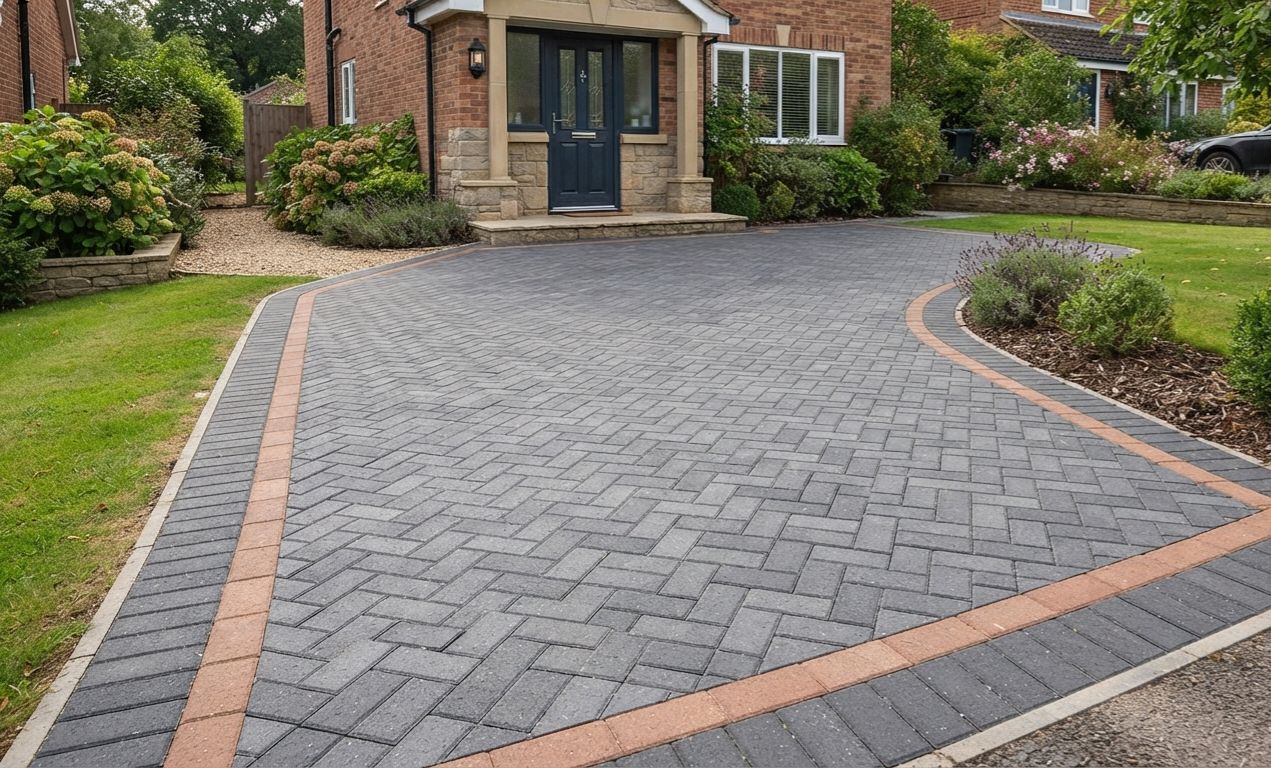
Charcoal block paving laid in a herringbone pattern with a contrasting red border course

Block paving

Block paving is the most forgiving patio surface there is. Each block is laid on a bed of sharp sand over a compacted sub-base and locked in by the joints and the edge restraint around it, so a single damaged block can be lifted and replaced without disturbing the rest. It suits a garden that gets real use, and it can be laid to match a block paved driveway at the front of the house.

The laying pattern changes the look completely. Herringbone and basketweave give a traditional finish, while a contrasting border course frames the patio and hides the cut line at the edges. Kiln dried sand is brushed into the joints and compacted in, and the whole surface is laid to a fall that takes water away from the house.

  • Compacted sub-base and sand bed
  • Single blocks lift out for easy repair
  • Herringbone, basketweave or stretcher bond
  • Contrasting border courses available

Patio design and setting out

We measure off the house and set string lines before anything is bedded, so the coursing runs true to the building rather than to a fence that was never square. Full slabs go where you walk and sit, cuts are pushed to the edges and behind planting, and the whole layout is dry laid and walked before a bag of mortar is opened.

Pointing

Joints are filled with a brush-in jointing compound that cures flexible, or with a proper mortar joint where the look calls for it. What we will not do is dry brush sand and cement across a patio and hope. That is why so many joints crack out and wash away in the first winter, and it is the most common repair we get called to.

Falls and drainage

Every patio is laid with a fall of roughly 1 in 80 running away from the house, and the finished surface sits at least 150mm below the damp proof course. Where a patio is enclosed or sits low, we run a linear channel drain into a soakaway so the water has somewhere to go instead of pooling against the brickwork.

Porcelain, sandstone, concrete flags or block paving

Four materials, four quite different jobs. Here is the honest version of what each one is good at and what you should know before you commit to it.

Pale grey porcelain patio with a timber bench and raised planting beds

Non-slip porcelain

What it suits

Modern houses and rear extensions with bi-fold doors, shaded or north facing gardens that go green quickly, and anyone who wants to jet wash once a year and forget about it. A 20mm R11 slab is the safest surface we lay around a pool or a hot tub.

What to know

It is the most expensive of the four to buy and the slowest to lay, because every slab is primed and every cut is made wet with a diamond blade. The colour is uniform by design, so if you want a patio that looks quarried rather than made, this is not it.

Warm toned natural sandstone patio beside a water feature and planted border

Natural Indian sandstone

What it suits

Period and cottage properties, brick and flint, anywhere the patio needs to look as though it has always been there. It is also the sensible choice for a large area on a set budget, because it covers more ground per pound than porcelain.

What to know

It is a porous natural stone. It darkens in the rain, it will pick up algae in deep shade, and it wants sealing once it has cured. Riven packs vary in thickness, so the bed depth is adjusted slab by slab. That is normal, but it takes longer to lay well.

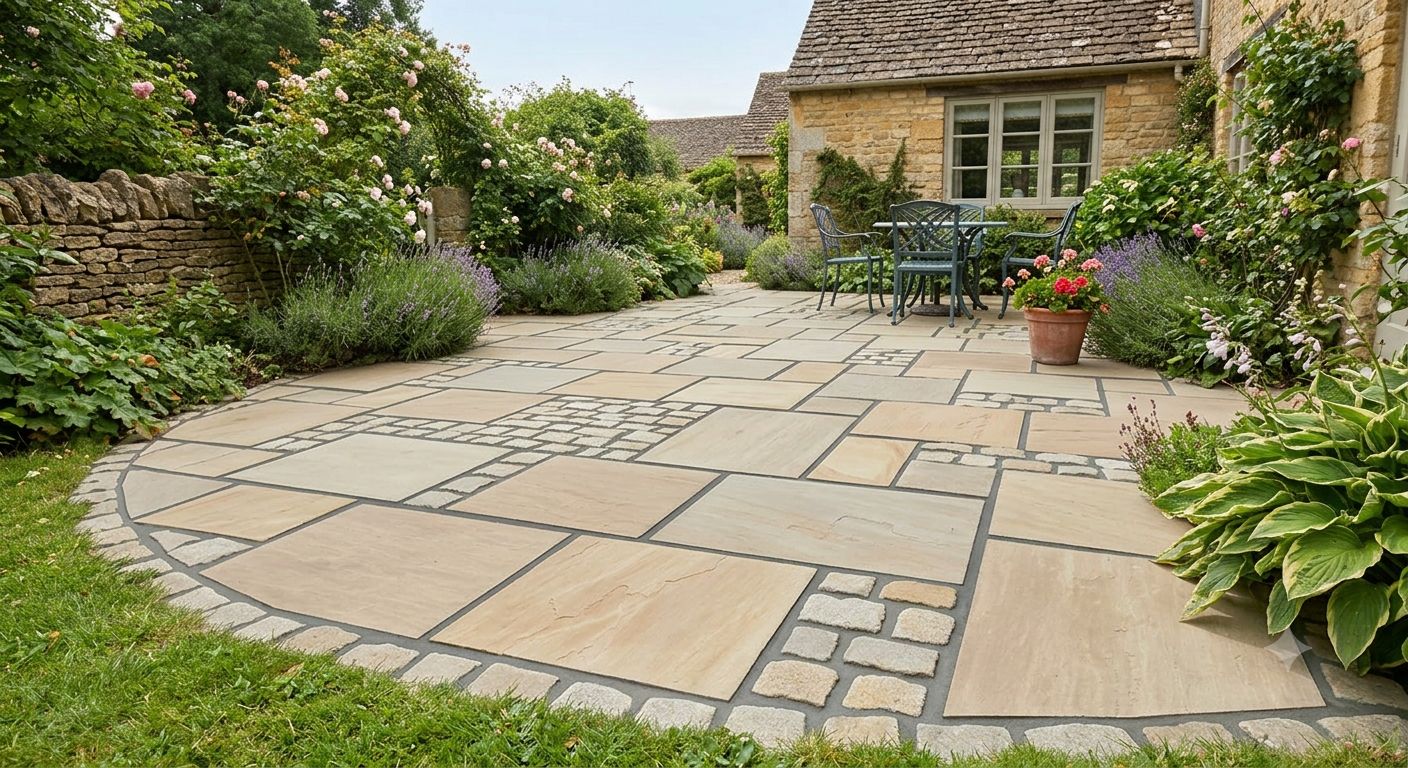
Concrete paving flags laid in a circular patio beside a cottage garden

Concrete flags

What it suits

Side returns, bin and bike stores, utility paths, workshop aprons, and large areas where budget matters more than finish. Flags are consistent in size and thickness, which makes them quick to lay and easy to lift and replace later.

What to know

Pigment is a surface treatment on most flags, so the colour softens over the first few years and worn edges show a paler core. A cheap flag can spall after a hard frost. Close up, a riven concrete flag reads as concrete, not as stone.

Block paving laid in a herringbone pattern with a contrasting border

Block paving

What it suits

Gardens that take real use, patios that sit alongside a block paved driveway, and anyone who wants a surface that can be repaired a block at a time. Patterns and border courses make it easy to frame the patio and tie it in to the house.

What to know

It is laid on a sand bed over a compacted sub-base rather than on mortar, so it relies on a solid edge restraint to stop it spreading. Weeds can take hold in the joints over time, which a polymeric jointing sand reduces. The finish is more textured and traditional than large format slabs.

Bring us a sample or a photograph you like and we will tell you which of the four it actually is, and what it will cost to lay across your garden.

Know what your patio will cost

We measure the area, check the levels against your damp proof course and quote the material, the sub-base and the drainage as separate lines. No day rates, no surprises.

The part you never see

How a patio is actually built

A patio is a small piece of civil engineering with slabs on top. Almost every failed patio we are asked to lift failed below the surface, not on it. This is the sequence we work to, and why each stage matters.

  1. Dig out to full depth

    We excavate 200mm to 250mm below the finished paving level and take out every bit of topsoil, root and old hardcore. Topsoil holds water and moves with the seasons, so anything laid on it will lift and dip. Spoil is carted away under our waste carrier licence, not buried at the end of the garden.

  2. Sub-base, compacted in layers

    100mm to 150mm of MOT Type 1 goes down in two passes, each one whacked separately with a plate compactor. Dumping the full depth and compacting once looks the same on the day and settles unevenly within a year. This layer, not the mortar, is what actually carries the load.

  3. Set the levels and the falls

    Levels are pegged off the house before any slab is bedded. The finished surface sits at least 150mm below the damp proof course and runs away from the building at roughly 1 in 80, about 12mm every metre. Enough to shed water, not enough to feel like a slope under a table.

  4. A full mortar laying course

    Every slab is bedded on a continuous mortar bed, not on five dabs at the corners. Spot bedding leaves voids underneath, and a void is where water sits, freezes and cracks the slab. On porcelain the back of each slab is slurry primed first, so the bond holds.

  5. Drainage, designed not added

    Where the fall alone cannot clear the water, a linear channel drain runs along the low edge into a soakaway or an existing surface water run. We never connect a patio to a foul drain. If the ground will not take a soakaway, we say so before we quote.

  6. Pointing the joints

    Joints are filled with a resin based brush-in compound, or a struck mortar joint where the material suits it. Both are worked in wet and cured properly. Dry brushed sand and cement is quicker and cheaper, and it is the single most common reason a two year old patio has weeds growing through it.

  7. Cleaning down and sealing

    The patio is washed off and left to dry and cure. Natural sandstone is then sealed, which slows staining and algae without changing the colour much. Porcelain does not need it. We hand over with plain aftercare advice rather than a maintenance contract.

Why a cheap patio fails

  • Laid straight onto soil or an old base, so it settles as the ground moves.
  • Spot bedded on dabs, leaving voids that crack slabs in the first frost.
  • Laid flat or falling back towards the house, so water pools against the brickwork.
  • Finished above the damp proof course, which is how damp gets inside a wall.
  • Dry brushed pointing that washes out and takes the weed seed straight in.
  • Porcelain bedded without priming, which lets go of the mortar within a couple of years.